
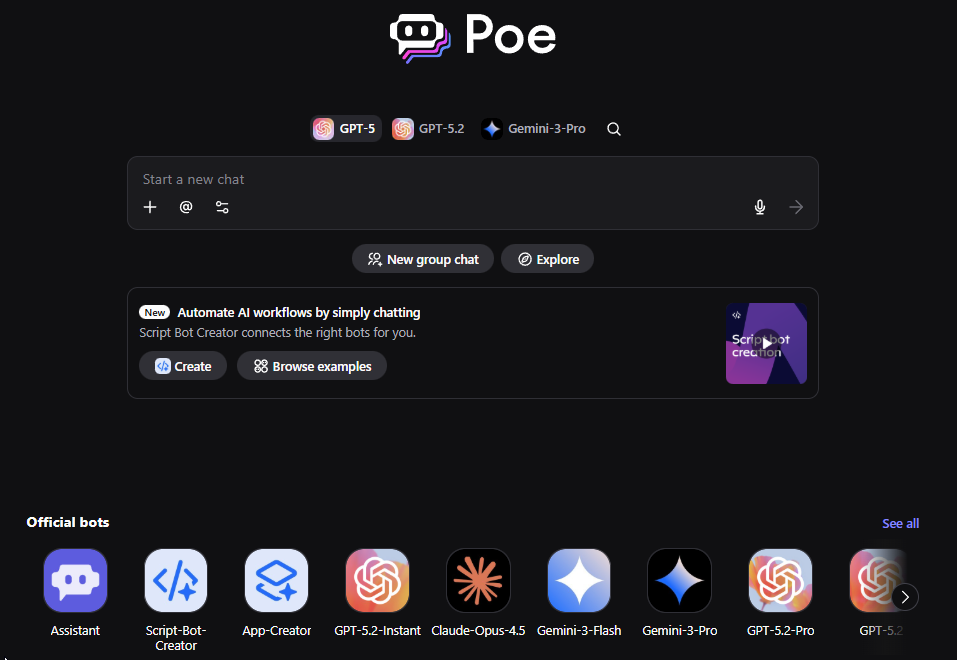
The real power isn't in picking one AI — it's in orchestrating many.
There is no single "best" AI. There are only tools that evolve, adapt, and occasionally surprise us. After three years of working with artificial intelligence—shipping code at 2am, drafting documents between meetings, exploring creative rabbit holes I never expected—I've learned something important: the real power isn't in picking one AI. It's in orchestrating many. This is the story of how Poe became my command center for the AI age.
The Beginning: Why I Chose Poe
It was early 2023. ChatGPT had just exploded into public consciousness, and suddenly everyone was talking about AI. I was excited—and overwhelmed. If I wanted to try ChatGPT, I needed an OpenAI account. Claude required Anthropic. Google had Bard behind its own gates. Every new model meant another login, another interface, another tab competing for my attention.
Then I found Poe.
Short for "Platform for Open Exploration," Poe was created by Adam D'Angelo, the co-founder of Quora. The pitch was simple: access every major AI model through one unified interface. No more juggling accounts. No more context switching. Just one clean space where GPT-4, Claude, Gemini, LLaMA, and dozens of others could coexist.
I signed up for the $20 monthly plan immediately. Back then, Poe used a message-based system—I could send around 500-600 queries per month to GPT-4. It felt like having a superpower.
What Makes Poe Special
The Unified Interface
Poe's design philosophy is elegant minimalism. Dark theme by default, clean sidebar for conversations, a search bar that surfaces any model you need. It feels less like enterprise software and more like a messaging app—which is exactly the point. The interface disappears, and you're left with just the conversation.
Seamless model switching mid-conversation — different perspectives emerge without losing context.
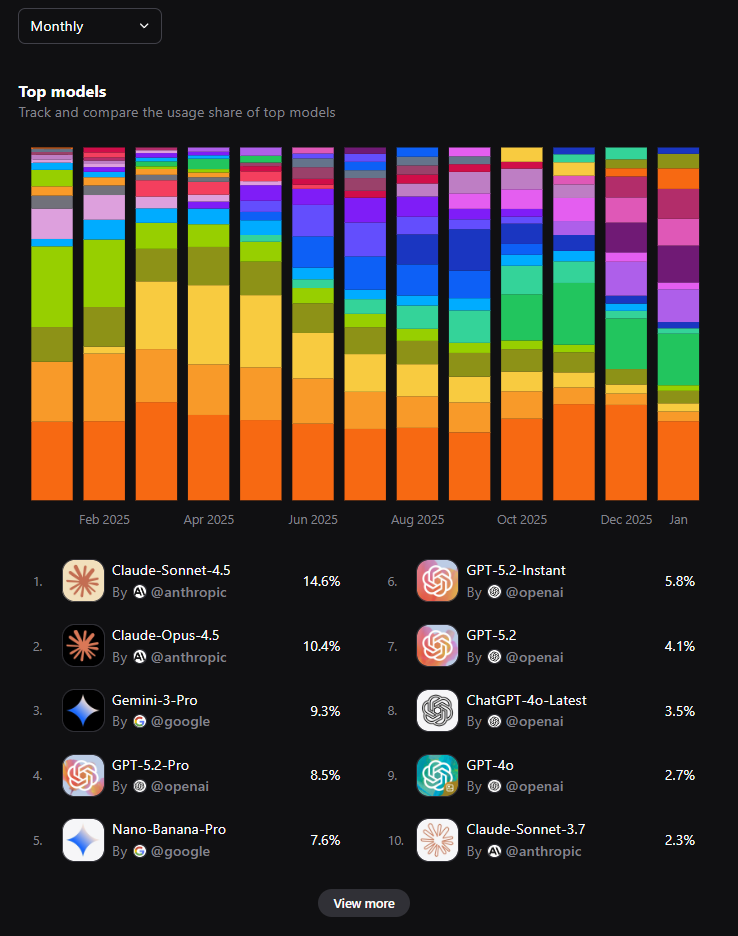
These numbers shift monthly. Today's favorite becomes tomorrow's afterthought when a better model drops. Having access to the entire ecosystem means I'm never locked into yesterday's technology.
Access Premium Models Without Breaking the Bank
Here's something that made Poe invaluable in my workflow: you can use flagship models like GPT-5.2-Pro without subscribing to OpenAI's expensive $200/month Pro plan. The same goes for Claude Opus and other premium models. Poe effectively democratizes access to cutting-edge AI—you're paying for compute time, not gatekept subscriptions.
One $20 subscription replaces multiple $20-$200 subscriptions across different providers.
Cross-Platform Sync That Just Works
Poe is available on web, macOS, Windows, iOS, and Android—and everything syncs seamlessly. Start a conversation on your desktop, continue it on your phone during commute, then pick it up on your tablet. All your custom bots, conversation history, and settings travel with you.
The Feature That Changed Everything: URL Parsing
This is the feature I tell everyone about. On Poe, you can paste any URL directly into the chat, and the platform will fetch the content for the AI to analyze. Documentation pages, news articles, research papers, remote images, PDFs—all fair game.
In 2023, when most AI models couldn't browse the web and had knowledge cutoffs from months ago, this was revolutionary. I'd paste a link to technical docs and get immediate analysis. No copying. No pasting. No wrestling with character limits.
No toggles. No premium add-ons. Just paste a URL and go.
Multi-Language Support
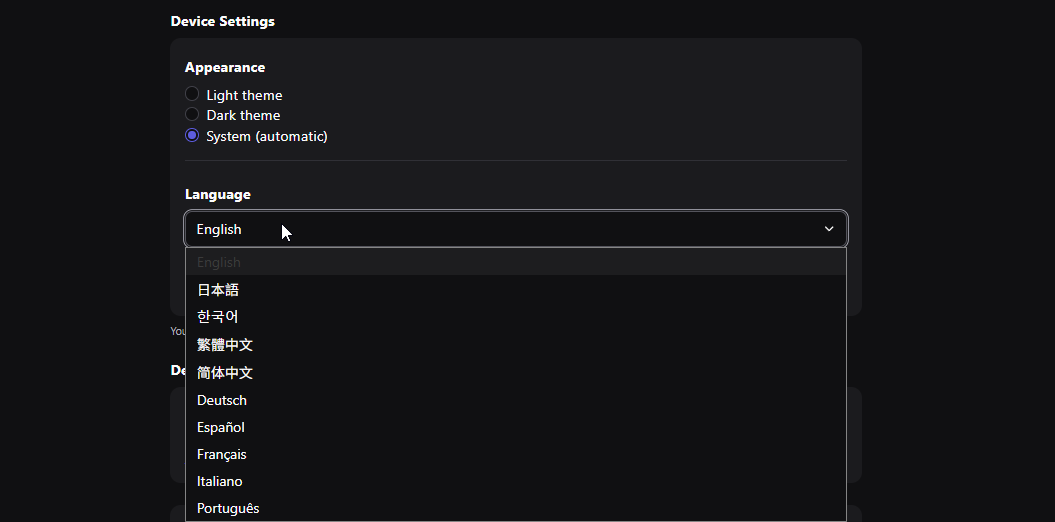
Poe natively supports English, Japanese, Korean, Traditional Chinese, Simplified Chinese, German, Spanish, French, Italian, and Portuguese. The entire interface localizes—not just labels, but the experience itself. For anyone working across language boundaries, this global-first approach matters.
Side-by-Side Model Comparison
One underrated feature: you can ask the same question to multiple models and compare their responses directly. This isn't just academic curiosity—it's genuinely useful for understanding which model handles your specific use case best. GPT might nail coding tasks while Claude excels at nuanced writing. Seeing the difference in real-time helps you develop intuition for model selection.
Regional Access Without VPNs
If you live somewhere that restricts access to certain AI services, Poe can be a lifeline. Users report successfully accessing models that would otherwise be geo-blocked, without needing VPNs or other workarounds. The platform handles the connectivity complexity behind the scenes.
From Message Counts to Points
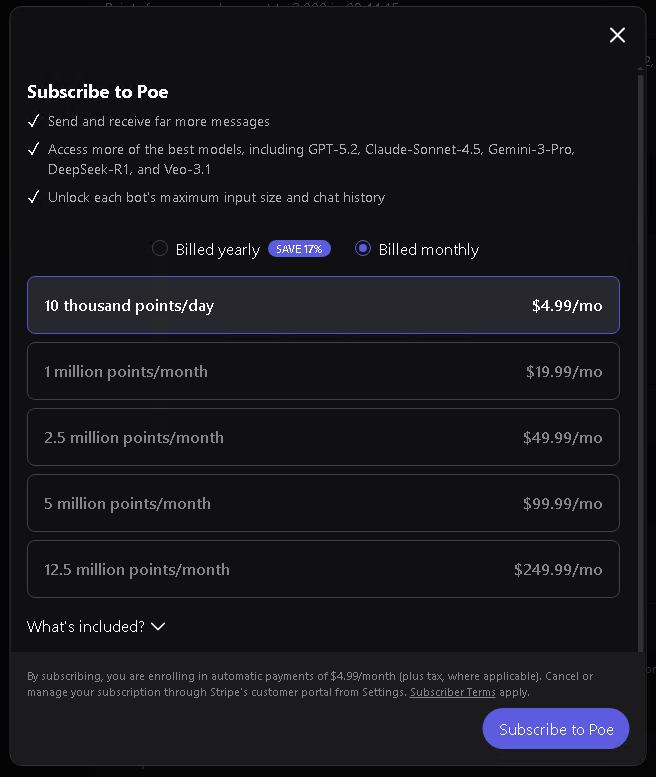
Somewhere along the journey—I honestly can't pinpoint exactly when—Poe shifted from counting messages to counting points. The $20/month subscription now grants 1 million compute points. Each AI interaction consumes points based on model complexity and response length.
The free tier is surprisingly generous. Everyone gets 3,000 points daily, resetting at midnight. For casual use—recipe questions, quick translations, homework help—this is more than enough. You genuinely never need to pay.
Current Pricing Breakdown
- Free: 3,000 points/day (resets daily)
- $4.99/month: 10,000 points/day
- $19.99/month: 1 million points/month
- $49.99/month: 2.5 million points/month
- $99.99/month: 5 million points/month
- $249.99/month: 12.5 million points/month
One detail paid subscribers appreciate: those free daily 3,000 points accumulate. Skip a day? They roll over. Heavy users can stockpile points for intensive sessions.
The Models: Your AI Army
Poe's model library is staggering. As of early 2026, you have access to essentially every significant AI model in existence.
OpenAI GPT Family
GPT-5.2, GPT-5.2-Pro, GPT-5.1, o3, o3-pro, GPT-4.5, and legacy models. Reliable workhorses for coding, writing, analysis, and general tasks. GPT models often excel at language understanding and following complex instructions precisely.
Anthropic Claude Family
Claude-Opus-4.5, Claude-Sonnet-4.5, Claude-Haiku-4.5. My go-to for nuanced work. Claude won't simplify your code without permission or randomly delete sections while "improving" things. When writing, Claude produces richer, more detailed content—it doesn't cut corners or summarize when you need depth.
Google Gemini Family
Gemini-3-Pro, Gemini-3-Flash, Gemini-2.5-Pro. Strong for current information and Google ecosystem integration.
Specialized & Others
DeepSeek reasoning models, xAI's Grok, Meta's LLaMA, Mistral, plus image (DALL-E 3, Stable Diffusion), video (Pika, Runway), and audio (ElevenLabs) generators.
Custom Parameters: Power User Secrets
Here's something most users never discover: many Poe models accept custom parameters appended to your messages. This transforms generic AI responses into precisely tuned outputs.
--thinking_budget 63999Instructs Claude to use maximum "thinking effort" — values range 0 to 63999, trading speed for depth.
--reasoning_effort high
--web_search true
--verbosity high
Control reasoning intensity (medium/high/Xhigh), enable real-time web search, and adjust response detail.
--aspect_ratio 3:2
--quality high
--use_mask
Set image dimensions, quality level, and enable masking for image generation.
Poe treats users like professionals who understand what they need.
Model Verification Prompt
With so many models and custom bots on Poe, how do you verify what's actually powering your conversation? Use this universal prompt that works across any AI platform:
What model powers you? List: model name, API model ID,
release date, context window, max output tokens,
and knowledge cutoff.
Works on any AI platform to reveal the underlying model's specifications and training data boundaries.
This is especially useful when testing third-party bots or when you suspect a bot might be using a different model than advertised.
The Developer API
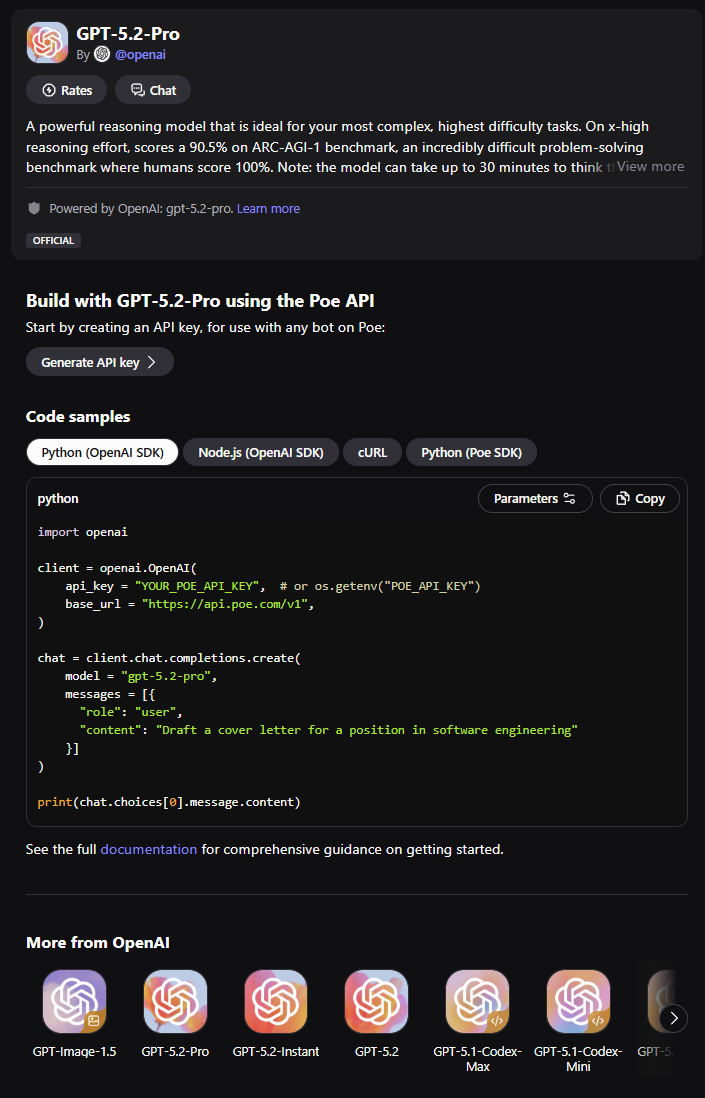
For developers, Poe offers something genuinely powerful: an API that's compatible with OpenAI's format. If you've built applications using OpenAI's SDK, you can point them at Poe with minimal code changes—and suddenly access every model on the platform.
import openai

client = openai.OpenAI(
    api_key = "YOUR_POE_API_KEY",
    base_url = "https://api.poe.com/v1",
)

chat = client.chat.completions.create(
    model = "gpt-5.2-pro",
    messages = [{
        "role": "user",
        "content": "Draft a cover letter for software engineering"
    }]
)

print(chat.choices[0].message.content)
Every model on Poe—including custom bots you create—can be accessed via API. Build applications that intelligently route queries to the best model for each task. Chain multiple AIs together. The architecture is yours to design.
Creating Custom Bots
One of Poe's most creative features is custom bot creation. No coding required—just define a personality, specify behaviors, and optionally upload a knowledge base. Your creation becomes accessible to anyone on the platform.
Select from Claude, GPT, Gemini, or others as your bot's foundation.
Define how your bot should behave, respond, and interact.
Add specialized expertise through document uploads.
Add avatars, descriptions, and greeting messages.
Charge per message or earn referral bonuses from new subscribers.
Bot creators earn real income — some have built genuine side businesses on the platform.
The Hard Truth: Why I Left
After nearly three years as a paying subscriber, I made a difficult decision last month: I didn't renew. This wasn't because Poe failed me—it was because my needs evolved, and the economics stopped making sense.
The Math That Made Me Leave
When I submit a 50KB PHP file to Claude-Opus-4.1 or o3-pro for analysis, I watch my points drain by 30,000-40,000 in a single query. A follow-up question—with context retention—costs another 30,000-50,000.
At $20/month with 1 million points, using premium models for serious development work, I could afford maybe 25-30 meaningful interactions. That's less than one real conversation per day.
This isn't Poe's fault. They're passing through API costs from OpenAI, Anthropic, and others. But it does mean Poe's value proposition varies dramatically based on how you use it.
Customer Support: The Other Challenge
Community feedback consistently mentions one pain point: customer support can be slow and sometimes unhelpful. If you encounter billing issues, technical problems, or need refunds, expect a potentially frustrating experience. This seems to be a common theme across reviews—the platform itself works well, but human support lags behind.
Privacy Considerations
If your work involves sensitive or regulated data, review Poe's privacy policies carefully. Your conversations pass through Poe's infrastructure before reaching the underlying model providers. For casual use, this is generally fine. For enterprise or compliance-sensitive work, you may want direct API access to specific providers instead.
Who Should Use Poe?
Perfect For: Casual Users
If you use AI occasionally—daily questions, homework, recipes, translations—the free 3,000 daily points are more than enough. You'll never hit the ceiling. Access world-class AI without spending anything.
Perfect For: Multi-Model Explorers
If your work involves comparing AI outputs or needs diverse capabilities (text, image, audio, video), the $20/month subscription is excellent value. Separate subscriptions to ChatGPT + Claude + image generators would cost far more.
Challenging For: Heavy Premium Users
If your workflow demands constant interaction with top-tier models—extended Claude Opus sessions, complex o3-pro reasoning, large-context analysis—the point consumption may prove frustrating. Consider direct subscriptions.
Pro Tips & Tricks
Three years of daily use taught me workflows that dramatically improve the Poe experience:
Don't burn premium points on first attempts. Draft with Claude-Haiku or GPT-3.5, then refine with Opus or GPT-5.2-Pro.
Before copying webpage content, try pasting the URL directly. Poe handles extraction and preserves context that manual copying loses.
Frequently ask similar questions? Build a custom bot with pre-loaded instructions. Saves tokens and improves consistency.
Click any bot's icon to see its consumption rate. Plan accordingly for expensive models like o3-pro or Claude Opus.
Poe's hidden fork feature branches conversations without losing the original. Perfect for exploring directions without commitment.
If the free daily points aren't enough but you can't justify a subscription, consider registering multiple free accounts. Each gets its own 3,000 daily points. Not elegant, but effective for light users.
Some third-party bots may not use the models they claim. Use the verification prompt to confirm what's actually responding to your queries.
Alternatives Compared
ChatGPT Direct
OpenAI's official platform. $20/month for GPT-4, Vision, DALL-E, and browsing. Best if you're exclusively in the OpenAI ecosystem.
Claude Direct
Anthropic's Claude Pro at $20/month. Deeper integration, longer context windows. For Claude devotees, the direct experience is smoother.
Google AI Studio
Impressive free tiers for Gemini models. Underrated option for developers and researchers who want powerful AI at zero cost.
Antigravity
Google's free AI agent (late 2025). Access to Claude Opus 4.5 and Gemini 3 Pro at no cost. My new recommendation for budget-conscious users.
Final Verdict
Free tier is genuinely generous
Unified access saves time and money
OpenAI-compatible API is valuable
Run the math for your specific patterns
Poe isn't perfect. Customer support can be slow. Premium models are expensive for heavy use. The point system feels restrictive at the high end. But as a unified gateway to AI—a command center for this strange new era—Poe remains one of the most thoughtfully designed platforms I've used.
My journey with AI continues, even if it's no longer exclusively through Poe. The workflows I developed, the understanding I gained—these travel with me. And when I need to quickly test a new model, compare responses, or spin up a custom bot, I know exactly where to go.
The emergence of AI hasn't made knowledge obsolete—it's made curiosity more powerful than ever. We're no longer limited by textbooks or years of specialized training. With the right tools and willingness to think, ordinary people can embrace an ocean of knowledge. Regardless of profession. Regardless of age. I hope to share this journey with friends around the world. Together, let's welcome this new world. Together, let's grow.

Discussion
0 commentsLeave a comment
Be the first to share your thoughts on this article!