
The AI isn't broken. Your prompts might be. The gap between what you want and what you get is almost always a communication problem, not an AI limitation.
Let me tell you about the moment I almost gave up on AI. I was sitting in my home office at 2 AM, deadline looming, staring at yet another useless response from ChatGPT. I had asked for help with something that should have been simple—creating product descriptions for an online store. Instead, I got generic fluff that sounded like it came from a marketing textbook written in 1995. "Experience the quality," it said. "Perfect for your needs." I could have written that nonsense myself in five seconds.
I was ready to declare that AI was overhyped garbage. But then, almost by accident, I discovered something that changed everything—not just how I use AI, but how I think about communication itself. This is the story of that discovery, and everything I've learned since about the invisible skill that separates people who struggle with AI from those who make it look like magic.
The Awakening - When I Finally Understood What AI Really Needs
The breakthrough came from the most unexpected place: a conversation with my eight-year-old niece. She was trying to get me to help her with a school project, and her requests were... well, exactly like mine to ChatGPT.
"Help me with my project," she said.
"What's the project about?" I asked.
"Stuff."
That's when it hit me. I had been approaching AI the same way—firing off vague requests and then getting frustrated when the responses didn't match what was in my head. The problem wasn't that AI couldn't help me. The problem was that I hadn't learned how to communicate with something that couldn't read my mind.
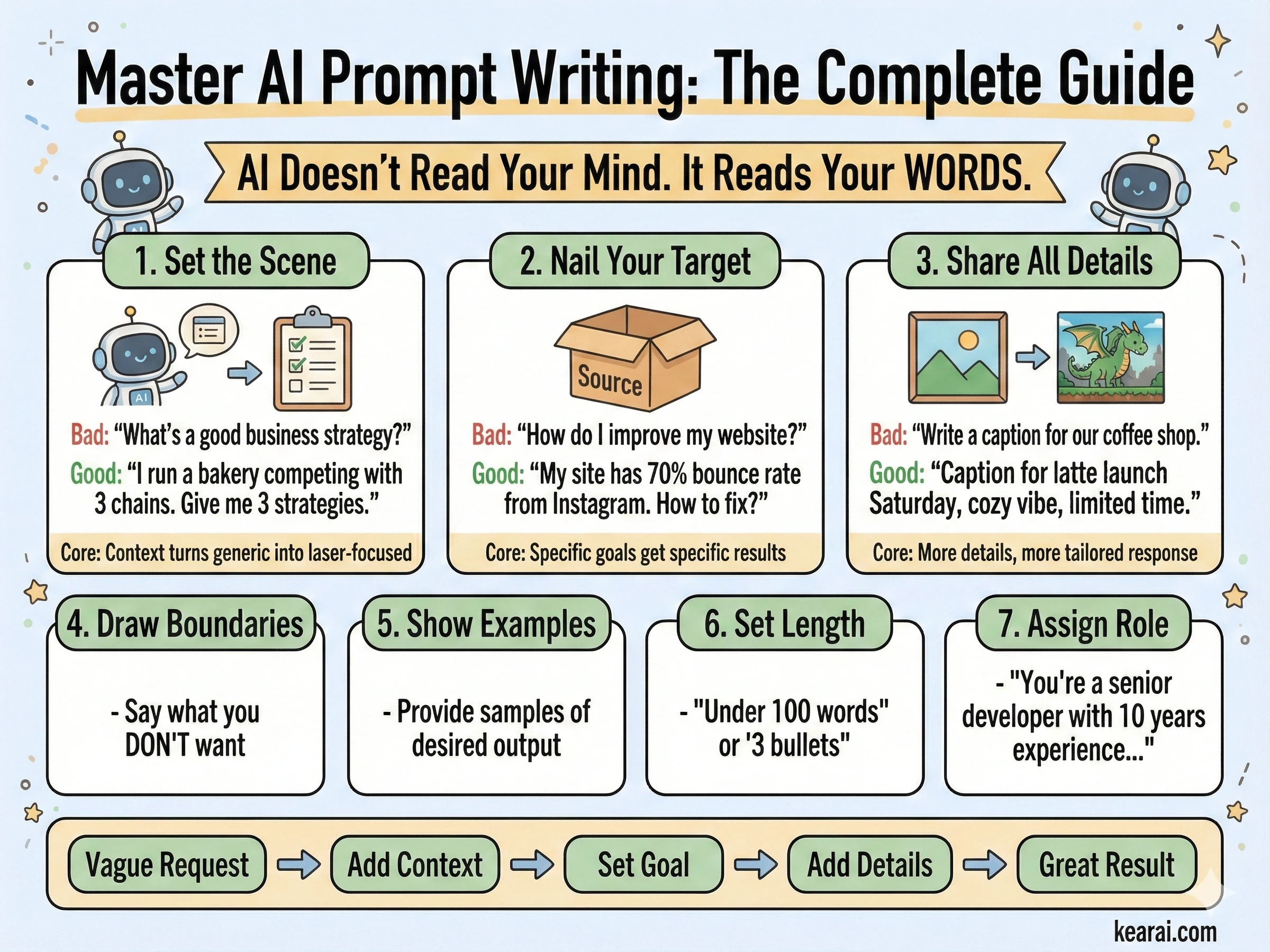
AI doesn't read your mind. It reads your words. The quality of your prompt determines the quality of your outcome. Period.
Think about it this way: when you write "help me with marketing," you get textbook advice anyone could Google. But when you write "create three Instagram campaign ideas for my sustainable fashion brand targeting eco-conscious millennials who care about transparency in manufacturing," you get actionable strategies tailored to your actual situation.
The difference between these two prompts is the difference between asking someone to "make dinner" versus "prepare a vegetarian pasta dish for four people using the ingredients in my pantry." One leaves everything to chance; the other sets you up for success.
This revelation sent me down a rabbit hole that consumed the next two years of my life. I devoured official documentation, research papers, and thousands of hours of experimentation. I studied how professional AI companies tune their prompts for production use. I talked to developers, marketers, educators, and hobbyists who were getting amazing results while others struggled.
What I discovered wasn't just tips and tricks—it was a complete paradigm shift in how to communicate with machines that think in patterns, probabilities, and tokens. And the beautiful thing is: these principles work for everyone, regardless of technical background.
Let me share everything I learned.
The Foundation - Three Practices That Change Everything
Before diving into advanced techniques, let me share the three foundational practices that transformed my AI interactions. Master these, and you'll already be ahead of 90% of AI users.
Practice 1: Set the Scene
Context is everything. Without it, AI defaults to generic responses that could apply to anyone—which means they're useful to no one.
Here's an example of what I mean:
The Vague Approach
"What's a good business strategy?"
AI gives textbook advice about vision, target markets, and competitive advantage—stuff you could find in any Business 101 guide.
The Context-Rich Approach
"I run a local bakery competing with three chain stores. What are 3 strategies to differentiate my business and increase customer loyalty?"
AI suggests emphasizing local/fresh/handmade aspects, building community through loyalty programs and events, and creating signature items the chains can't replicate.
See the difference? The phrase "local bakery competing with three chain stores" transforms everything. Without context, AI defaults to generic theory. With context, every suggestion becomes laser-focused on your reality.
Practice 2: Nail Your Target
Vague goals produce vague results. The more specific your objective, the more useful AI's response becomes.
The Vague Goal
"How do I improve my website?"
AI lists generic tips about speed, navigation, and SEO that apply to any website on the planet.
The Specific Goal
"My photography portfolio website has a 70% bounce rate. How can I improve engagement for potential clients visiting from Instagram?"
AI focuses specifically on matching Instagram expectations, mobile optimization, speed improvements, and clear CTAs for booking sessions.
Notice how the specific goal ("reduce bounce rate from Instagram") immediately focuses AI on mobile optimization and visual consistency—exactly what Instagram visitors need. Without it, you get scattered tips that may miss your actual problem entirely.
Practice 3: Share All the Details
The more information you provide, the more tailored the response. Don't make AI guess.
Minimal Input
"Write a social media caption for our coffee shop."
"Start your day right with a cup of coffee from us! ☕ #coffeetime #morningvibes"
Complete Information
"Write a social media caption for our coffee shop. We're promoting our new honey cinnamon latte, which launches this Saturday. It's only available for a limited time, and we want the caption to sound warm and inviting, with a cozy autumn vibe. Mention that it's handcrafted, and add a soft call-to-action encouraging people to stop by this weekend."
"Warm up to something new 🍯✨ Our handcrafted Honey Cinnamon Latte arrives this Saturday, just in time for sweater weather. Available for a limited time, so come cozy up with us this weekend while it lasts! #FallFeels #CoffeeSeason"
The detailed prompt packs in everything: tone ("warm," "cozy"), specifics ("honey cinnamon latte," "Saturday"), constraints ("limited time"), and desired outcome ("soft call-to-action"). This transforms a generic response into exactly what you envisioned.
Pro Tip: Don't worry about perfect grammar. Bullet points, fragments, or keywords work fine. "honey cinnamon latte, Saturday launch, limited time, cozy autumn feel, handcrafted, weekend CTA." AI understands patterns and intent, not just complete sentences.
The Refinements - From Good to Exceptional Results
Once you've mastered the foundation, these refinements will elevate your results from good to exceptional. Think of them as precision tools that give you fine-grained control.
Refinement 1: Draw the Boundaries
Sometimes the best way to get what you want is to explicitly state what you DON'T want. This eliminates entire categories of generic responses.
Help me write a product description for my handmade soap.

Please avoid:
- Generic phrases like "crafted with care" or "perfect for daily use"
- Anything that sounds overly salesy or cliché
- Vague claims without specific benefits

Instead, make it informative and down-to-earth, highlighting
the unique natural ingredients and their skin benefits.
By explicitly stating what you DON'T want, you create a map with clearly marked "no-go zones." This saves revision time and gets you closer to your vision on the first try.
Refinement 2: Show, Don't Just Tell
Examples are worth a thousand descriptions. When you show AI what you want, it can mirror your style, structure, and tone perfectly.
I need to ask my boss for a deadline extension on the quarterly report.

Here's what I drafted:
"Hi Sarah, I'm behind on the quarterly report and need more time.
I found errors in the Q2 numbers that I need to consult with the
finance team. Can I have until Friday? Thanks, Mike."

Please polish this while maintaining my casual-but-professional tone
and the specific details I included.
This approach reveals crucial context that instructions alone can't capture: your relationship dynamics, communication style, and specific circumstances. AI uses your example as a template, maintaining your voice while enhancing clarity.
Refinement 3: Control the Length
Length constraints force AI to prioritize. Instead of comprehensive coverage, you get concentrated wisdom.
Length Guidelines That Work
- Quick reference: "Under 100 words"
- Social media: "Tweet-length" or "280 characters max"
- Executive summary: "One paragraph"
- Detailed guide: "500-750 words with examples"
- In-depth article: "2000+ words with sections"
Refinement 4: Give AI a Role to Play
This is one of my favorite techniques. By assigning a specific persona, you transform AI from a generic information provider into a seasoned expert with "lived experience."
You're a senior project manager who has successfully led remote teams
for 10 years across 12 time zones.

Write a LinkedIn post sharing unconventional productivity tips that
actually work for distributed teams, based on your experience.

Keep it practical and avoid generic advice like "create a dedicated
workspace" that everyone already knows.
The more specific your persona, the more nuanced the response. Don't just say "marketing expert." Try "B2B SaaS marketing director who specializes in product-led growth for developer tools." Watch how the advice shifts from generic to laser-focused.
The Six Mindsets That Unlock AI's Hidden Potential
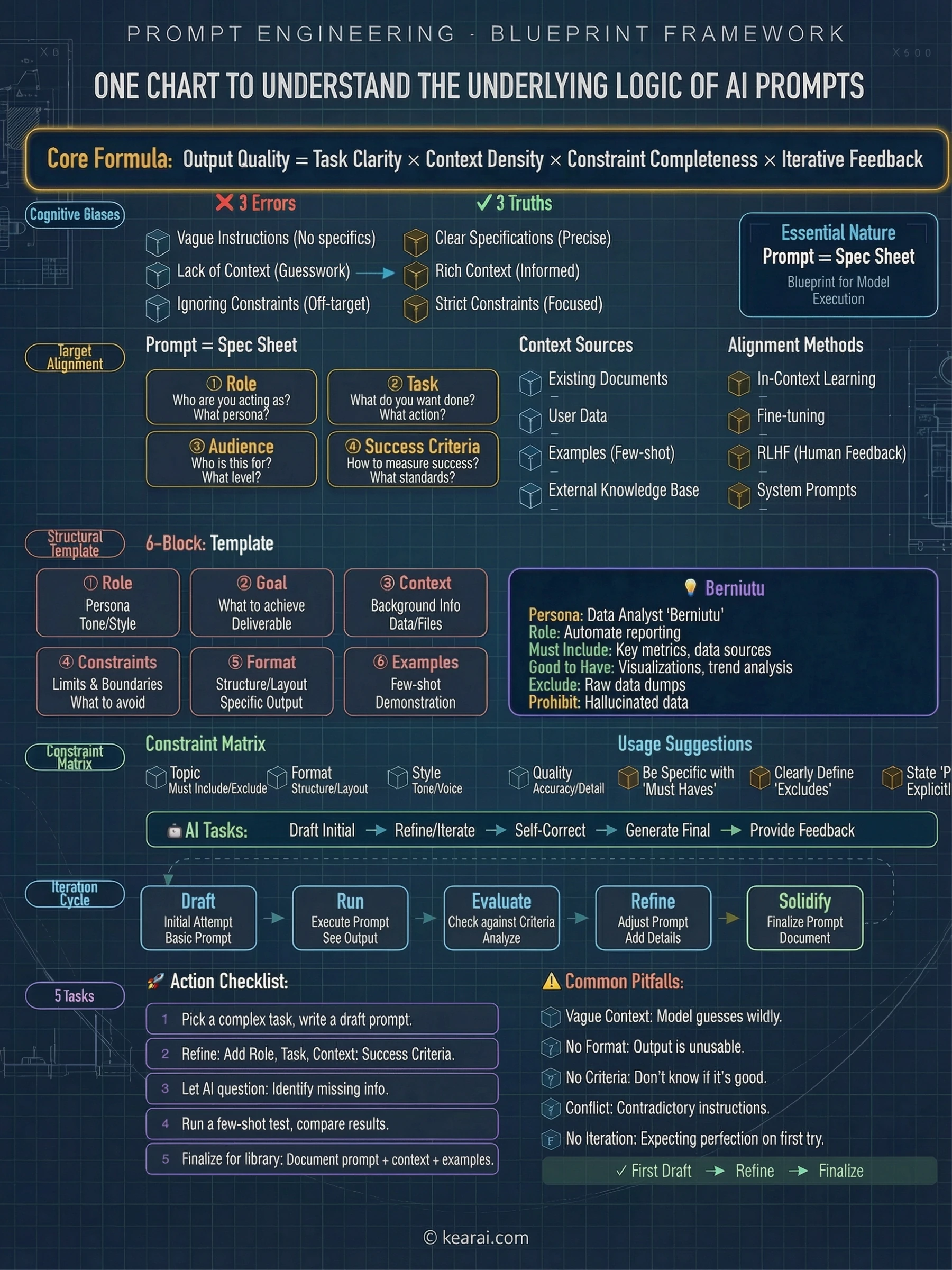
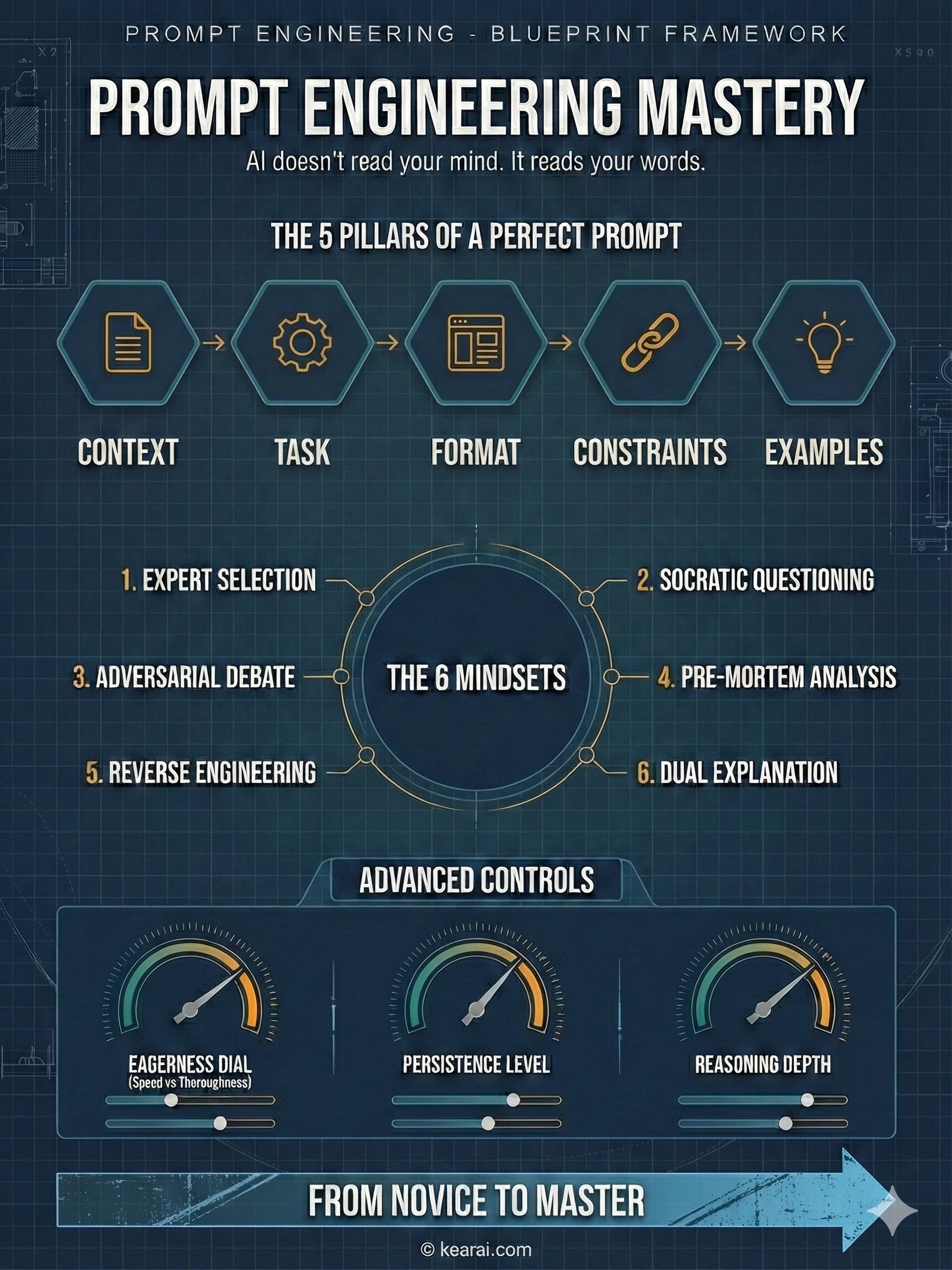
After years of experimentation, I've distilled my approach into six core "mindsets"—flexible thinking patterns that unlock capabilities most people never discover.
Mindset 1: Let AI Choose the Expert
We all know giving AI a role helps. But here's what most people miss: when you don't know which expert would be best, you can ask AI to choose.
I want to explore [YOUR DOMAIN] and specifically [YOUR PROBLEM].
Don't answer yet.

First, select the most suitable domain expert to think about this problem.
They can be living or historical, famous or relatively unknown,
but must be genuinely excellent in this specific area.

Output:
1. Who you selected and their specific domain
2. Why you chose them (three sentences)

Then ask me to describe my detailed question.
I used this when planning a company event. AI selected Priya Parker—an event design expert I'd never heard of but who turned out to be perfect. The answers I got weren't generic "consider these five factors" responses—they were nuanced, specific guidance that felt like talking to someone who had done this hundreds of times.
Mindset 2: Let AI Ask Questions First
This is the technique I use more than any other. Instead of trying to anticipate everything AI needs, I let it ask me questions until it has enough context.
[YOUR QUESTION OR NEED]

Before answering, please ask me questions first.

Requirements:
- Ask one question at a time
- Based on my answers, continue probing
- Keep going until you have 95% confidence you understand
  my true needs and goals
- Only then give me your answer or solution

The 95% threshold ensures quality while avoiding endless loops.
I used this when deciding whether to hire our first HR person. Instead of getting generic "pros and cons" advice, AI asked about our team size, hiring velocity, compliance requirements, budget constraints, and culture goals. After about fifteen targeted questions, I got advice specific to my actual situation—not textbook guidance.
Mindset 3: Debate with AI
AI has a problem: it's too agreeable. It often tells you what you want to hear rather than challenging your assumptions. The solution is to explicitly position AI as an adversary.
I'm about to present this thesis: [YOUR IDEA/POSITION]

I need this idea to become bulletproof before I share it publicly.

If you were a scholar determined to prove me wrong, using every
available argument, detail, and logical tool, how would you attack
my position?

Your only goal: demonstrate that I am wrong.
Do not be gentle. Do not hedge. Attack.
When I used this preparing for a conference talk, we went back and forth for three hours. AI found weaknesses I hadn't considered, raised counterexamples I couldn't dismiss, and pushed me to refine my position until it could withstand real scrutiny.
Mindset 4: Pre-Mortem Your Plans
Humans tend to be optimistic when planning. The pre-mortem technique flips this: instead of asking "How should I do this?", you ask "Imagine this failed spectacularly—why?"
[YOUR PROJECT OR PLAN]

Assume this project failed catastrophically.

Write a post-mortem analysis answering:
1. At what point did decay signals first appear?
2. What was the most fatal decision error?
3. What core risk was overlooked?
4. If you could go back, what's the first thing you'd change?

Base your analysis on similar real-world project failures.
Write this as a genuine failure retrospective.
When planning a conference, AI's pre-mortem identified risks I had completely missed: queue management, bathroom capacity, catering timing, security bottlenecks. These weren't exotic edge cases—they were predictable problems I hadn't thought about because I was focused on the exciting parts.
Mindset 5: Reverse Engineer Success
When you see something excellent and want to replicate its essence, reverse prompting extracts the underlying principles.
This is an example of the result I want:

[PASTE EXAMPLE]

Please reverse-engineer a prompt that would reliably generate
content with this same style, structure, and quality.

Explain what each part of the prompt does and why it matters.
Mindset 6: The Dual Explanation Method
When learning something new, most people get either oversimplified explanations or expert-level content they can't follow. Ask for both simultaneously.
Please explain [CONCEPT].

Provide two versions:

1. Beginner version: Imagine explaining to someone with no
   background in this field. Use everyday analogies and avoid
   all jargon. Make it genuinely understandable.

2. Expert version: Assume the reader is a professional in a
   related field. Be technically precise. Don't oversimplify.
I use this constantly when reading technical papers. The beginner version gives me intuition; the expert version gives me precision. By comparing them, I can see exactly where the simplifications are.
Real-World Applications - Stories That Will Inspire You
Theory is useful, but let me show you how real people are using these techniques to transform their work and lives. These aren't hypothetical examples—they're actual use cases I've seen or experienced.
The magic of AI prompting isn't about fancy techniques—it's about helping ordinary people do extraordinary things they never thought possible.
For E-Commerce Professionals - Turning AI Into Your Marketing Partner
This is where my AI journey really began, so let me share what I learned the hard way.
The average e-commerce store has hundreds—sometimes thousands—of products. Writing unique, compelling descriptions for each one would take months of full-time work. But generic AI output makes your store sound like every other faceless online shop.
The solution? A structured approach that captures your brand voice while scaling infinitely.
Product Description Framework
<brand_voice>
We're an outdoor gear company for serious adventurers. Our tone is
confident but not arrogant, technical but accessible. We never use
corporate buzzwords or fake enthusiasm. Think: knowledgeable friend
who's actually used this stuff in the wild.
</brand_voice>

<product>
Name: TrailMaster 65L Backpack
Key features: 65-liter capacity, waterproof zYp system,
adjustable torso length (15-22"), hip belt pockets,
load lifters, hydration sleeve, rain cover included
Price point: $189 (mid-range)
Target customer: Weekend warriors and thru-hikers who need
versatility without breaking the bank
</product>

<competitor_context>
Similar packs from Osprey and Gregory cost $250+. Our advantage
is the waterproof zipper system at this price point.
</competitor_context>

<requirements>
- Write a 150-word product description
- Lead with the key benefit, not features
- Include one specific use case scenario
- End with subtle scarcity or urgency (but not fake)
- Don't use: "revolutionary," "game-changing," or "best in class"
</requirements>
Notice how this prompt gives AI everything it needs: brand voice, product specifics, competitive context, and explicit constraints. The result sounds like it was written by someone who knows and loves the product—not a robot.
Bulk Product Data Processing
One e-commerce manager I know had 2,000 products that needed updated descriptions. Using a structured template system, she processed them all in two days instead of two months. Her secret? Variables.
Generate a product description using this template:

Product: {{product_name}}
Category: {{category}}
Price: {{price}}
Key Features: {{features}}
Target Audience: {{audience}}

Apply our brand voice (casual, helpful, zero hype) and output:
1. Headline (under 10 words)
2. Description (100-150 words)
3. Three bullet points highlighting benefits
4. One customer use case

---
{{product_name}} = "Sunrise Yoga Mat"
{{category}} = "Fitness Equipment"
{{price}} = "$45"
{{features}} = "6mm thick, non-slip surface, includes carrying strap"
{{audience}} = "Home yoga practitioners who want durability without
premium prices"
Customer Review Response System
Another game-changer: responding to customer reviews. Most businesses either ignore reviews or send obviously templated responses. With AI, you can craft personalized responses at scale.
You're our customer service manager responding to this review:

Review: "The hiking boots were comfortable but started leaking
after just 3 uses. Disappointed since I paid $120 for them."

Our policy: 90-day satisfaction guarantee, free returns/exchanges

Respond with:
- Genuine acknowledgment of the issue (not corporate apologize-speak)
- Specific solution offer
- Brief mention of our guarantee
- Invitation to contact support directly
- Keep it under 100 words
- Sign as "Marcus, Customer Care"
The key is making each response feel personal while maintaining consistency. Customers can tell the difference between "We apologize for any inconvenience" and "That's frustrating—waterproof boots that leak defeat the whole purpose."
For Developers - Coding with AI Even in Languages You Don't Know
Here's a story that still amazes me. A friend of mine—a Python developer with no Rust experience—needed to refactor a legacy application written in Rust. The original developer had left the company, documentation was sparse, and deadlines were tight.
Traditional approach: spend weeks learning Rust fundamentals, then weeks more understanding the codebase, then attempt the refactor. Total time: months.
AI-assisted approach: use structured prompts to understand the codebase, get AI to explain unfamiliar patterns, and implement changes with constant verification. Total time: one week.
Understanding Unfamiliar Code
I'm a Python developer with no Rust experience. I need to understand
this Rust function before modifying it.

<code>
[PASTE RUST CODE HERE]
</code>

Please explain:
1. What this function does in plain English
2. The Rust-specific patterns used (with Python equivalents if possible)
3. Potential issues or edge cases
4. What would happen if I changed [specific part]

Assume I understand programming concepts but not Rust syntax.
Safe Refactoring
I need to refactor this function to [DESCRIBE GOAL].

<current_code>
[PASTE EXISTING CODE]
</current_code>

<constraints>
- Must maintain backward compatibility
- Cannot change the public API
- Must improve performance for large datasets
</constraints>

Please provide:
1. The refactored code
2. Explanation of each change
3. Test cases that verify the refactor works correctly
4. Any potential risks I should watch for
The Code Review Partnership
One of the most powerful uses of AI in coding isn't writing code—it's reviewing it. Here's how I use AI as my always-available senior developer:
Review this code as if you're a senior developer who is:
- Obsessive about edge cases
- Paranoid about security
- Allergic to technical debt

<code>
function processUserPayment(userId, amount) {
    const user = getUser(userId);
    user.balance -= amount;
    saveUser(user);
    return { success: true };
}
</code>

Identify:
1. Bugs waiting to happen
2. Security vulnerabilities
3. Missing error handling
4. Scalability concerns
5. Code quality improvements

Be brutal. I want to find problems before production does.
AI might respond with: "No validation that user exists. No check that amount is positive. No verification user has sufficient balance. No transaction safety—if saveUser fails, balance is already decremented in memory. No rate limiting. Consider race conditions with concurrent requests..."
This kind of thorough review would take a human reviewer 30 minutes. AI does it in seconds.
For Parents - AI as Your Child's Personal Tutor
This application changed how I think about education's future. Let me tell you about Maria.
Maria is a single mother working two jobs. She never finished high school, and when her 10-year-old struggles with math homework, she feels helpless. Hiring a tutor costs $50-100 per hour—money she doesn't have. She wants desperately to help her daughter succeed but doesn't know how.
With AI prompting skills, Maria became her daughter's personal tutor. Not by knowing the answers herself, but by knowing how to ask AI the right questions.
Generating Practice Problems
Maria's daughter kept making the same mistakes on fraction problems. Instead of random practice, Maria used AI to generate targeted exercises:
My 10-year-old daughter keeps making these specific mistakes
with fractions:
- Forgetting to find common denominators before adding
- Confusing the numerator and denominator when comparing
- Not simplifying final answers

Please create:
1. Five practice problems that specifically target these errors
2. For each problem, explain the "trap" a student might fall into
3. A simple explanation of the correct approach (in kid-friendly language)
4. One real-world example showing why this matters

Make the problems progressively harder. Use contexts a 10-year-old
would find interesting (pizza, video games, allowance money).
Step-by-Step Explanations
My daughter is confused about why 1/2 + 1/3 doesn't equal 2/5.

Explain this to a 10-year-old using:
- A pizza analogy (she loves pizza)
- Visual representation she could draw
- Step-by-step process she can follow for similar problems

Avoid: mathematical jargon, assuming she already understands
common denominators, making her feel dumb for being confused.

End with an encouraging message about how this confuses
many students at first.
Creating Study Plans
My daughter has a math test in one week covering fractions, decimals,
and percentages. Based on her current struggles:
- Fractions: intermediate level, occasionally forgets steps
- Decimals: strong, confident
- Percentages: weak, doesn't understand the concept well

Create a 7-day study plan that:
- Focuses more time on weak areas
- Uses her strong area (decimals) to help explain percentages
- Includes 15-minute sessions (her attention span limit)
- Builds confidence, not just knowledge
- Ends with a practice mini-test

We can study together each evening after dinner.AI doesn't replace good parenting—it amplifies it. Maria's love and involvement combined with AI's infinite patience and knowledge created something powerful: personalized education accessible to everyone, regardless of background or income.
Beyond Math: Learning Any Subject
The same approach works for any subject. History essays, science projects, language learning, test preparation. The pattern is always the same:
- Identify the specific struggle (not just "bad at history" but "trouble connecting causes to effects in historical events")
- Request targeted practice at the right difficulty level
- Ask for explanations using contexts the child enjoys
- Build confidence through progressive success
For Writers and Creators - Unlocking Your Creative Potential
Let me be clear about something: AI doesn't write for you. It writes WITH you. The best creative use of AI isn't generating content—it's breaking through creative blocks, exploring ideas, and enhancing your unique voice.
Overcoming Writer's Block
I'm writing a novel about [BRIEF PREMISE] and I'm stuck at this point:

[DESCRIBE WHERE YOU ARE IN THE STORY]

My character needs to [GOAL] but I can't figure out how to make it
interesting and authentic to who they are.

Character details:
- Personality: [KEY TRAITS]
- Background: [RELEVANT HISTORY]
- What they fear: [FEAR]
- What they want most: [DESIRE]

Give me five different directions this scene could go, ranging from
subtle to dramatic. For each, explain what it reveals about the
character and how it could affect later plot points.

Don't write the scene—just give me the possibilities to spark my
own thinking.
Voice Development
Here's a sample of my writing:

[PASTE 500+ WORDS OF YOUR WRITING]

Analyze my writing style, identifying:
1. Distinctive patterns in sentence structure
2. Word choice tendencies
3. How I handle dialogue vs. description
4. My narrative distance (close/distant)
5. Recurring strengths to lean into
6. Patterns that might bore readers if overused

Be honest and specific. I want to understand my voice, not receive
compliments.
Research Assistant
Writing historical fiction? Creating a sci-fi world with believable technology? AI becomes your research partner:
I'm writing a story set in 1920s Shanghai. I need to understand:

1. Daily life details: What did people eat for breakfast? What
   did streets smell like? What sounds would wake someone up?

2. Social dynamics: How would a wealthy Chinese merchant interact
   with a British businessman? What would be said vs. left unsaid?

3. Historical accuracy: What major events happened in 1923-1924
   that might affect my characters' lives?

Please provide specific, sensory details I can use to make scenes
feel authentic. Flag anything that might be commonly misrepresented
in Western fiction about this period.
Editing Partnership
Here's a chapter from my novel. I suspect something's wrong with
the pacing but can't identify it.

[PASTE CHAPTER]

Read this as an editor focused on:
1. Where does momentum stall?
2. Which scenes could be cut without losing anything important?
3. Where am I telling instead of showing?
4. What's unclear that I think is clear (author blindness)?
5. Where could I trust the reader more?

Be specific with line references. Don't fix it for me—help me
see what I'm missing.
For Small Business Owners - Competing with the Giants
Here's the reality: big companies have marketing departments, legal teams, HR specialists, and business analysts. Small business owners have... themselves. AI changes this equation dramatically.
Marketing on a Budget
<business_context>
I run a local bakery in a small town. We're competing with three
chain stores (Panera, Starbucks, a regional chain). Our advantages:
everything baked fresh daily, family recipes, we know customers by name.
Our limitations: tiny marketing budget ($200/month), just me and
two part-time employees, can't compete on convenience or price.
</business_context>

<current_situation>
Most customers are regulars, but we're not growing. Foot traffic
from tourists goes to the chains because they don't know we exist.
We have an Instagram but only post occasionally.
</current_situation>

What are 5 marketing strategies that:
- Cost under $200/month (or are free)
- Don't require a marketing expert to execute
- Play to our strengths (local, personal, quality)
- Could show results within 60 days

For each strategy, tell me exactly how to implement it, including
specific first steps I could take tomorrow morning.
Legal and Compliance Help
(Note: AI doesn't replace lawyers for serious legal matters, but it can help you understand basics and know what questions to ask.)
I'm starting a home-based food business in California, making
and selling artisanal jams at farmers markets.

Help me understand:
1. What permits/licenses are typically required?
2. What are cottage food laws and do they apply to me?
3. What food safety requirements should I know about?
4. What insurance should I consider?
5. What questions should I ask a local small business lawyer?

I don't need legal advice—I need to understand the landscape so
I can have an informed conversation with professionals and not
waste money asking basic questions at $300/hour.
Customer Communication
A customer left an angry 1-star review saying we refused to
honor an expired coupon and "the staff was rude about it."

What actually happened: The coupon expired 6 months ago. We
offered a 10% discount as a goodwill gesture. The customer
became verbally abusive to our teenage employee, who stayed
professional but was visibly upset.

Help me craft a response that:
- Shows we take feedback seriously
- Gently sets the record straight without being defensive
- Doesn't throw our employee under the bus
- Leaves the door open for the customer to return
- Demonstrates to other readers that we handle situations fairly

Keep it under 150 words. Professional but warm, not corporate.
Business Planning
I'm considering opening a second location for my successful
coffee shop. Help me think through this decision.

Current situation:
- One location, profitable for 3 years
- Revenue: ~$400K/year, profit margin ~15%
- Staff: 6 employees, running smoothly
- I still work in the shop daily

Potential second location:
- Similar neighborhood, 15 minutes away
- Rent is 20% higher than current location
- Would require $80K investment to build out

I need a framework for making this decision:
1. What financial metrics should I hit before expanding?
2. What operational prerequisites need to be in place?
3. What are the hidden costs people forget?
4. What's a realistic timeline?
5. What's the worst-case scenario and how would I handle it?

Be realistic, not encouraging. I want to know the hard truths.
Advanced Techniques - Think in Tags, Steps, and Variables
Now let's level up. These advanced techniques will transform your prompts from good to professional-grade.
Think in Tags
When prompts get complex, structure prevents confusion. XML-style tags create clear boundaries between different types of content.
<product>
The AquaPure water filter removes 99% of contaminants,
improves taste, and is easy to install. Ideal for homes,
offices, and travel.
</product>

<headline words="7">
Write a headline exactly 7 words long.
</headline>

<summary words="20">
Write a summary exactly 20 words long.
</summary>

<bullets count="3" max_words_per_bullet="6">
Create exactly 3 bullet points; each must be 6 words or fewer.
</bullets>

<paragraph min_words="40" max_words="50">
Write one paragraph between 40 and 50 words long.
</paragraph>
Each instruction is clearly separated, with parameters like words="7" spelling out exact requirements. AI has a blueprint to follow with no room for guesswork.
Think in Steps
Complex tasks benefit from explicit step-by-step reasoning. This approach, called chain-of-thought prompting, improves accuracy dramatically.
Let's solve this in steps:

1. Calculate total revenue
2. Calculate total production cost
3. Subtract production cost and overhead from revenue to get profit
4. Show each step before giving the final answer

Problem: Calculate the total profit if a store sells 350 units
at $45 each, with a production cost of $28 per unit, and a
fixed overhead of $2,500.
Without steps, AI might jump straight to an answer and make calculation errors. With steps, it verifies each stage before moving on.
Think in Variables
Variables turn static prompts into reusable templates. Define values once, change them anywhere.
Write a 150-word product page for {{product_name}}.
Mention {{product_name}} at least 3 times, highlight its
{{key_feature}}, and explain how it's perfect for {{target_audience}}.
Use an enthusiastic tone.

{{product_name}} = "SolarFlow 3000"
{{target_audience}} = "remote workers"
{{key_feature}} = "fast charging speed"

---

[Later, just change the variables]

{{product_name}} = "EcoCharge Pro"
{{target_audience}} = "digital nomads"
{{key_feature}} = "solar-powered efficiency"
Variables make prompts efficient to maintain and easy to scale. Change the product name once, and it updates everywhere.
The Agentic Mindset - Treating AI as Your Colleague
Here's a paradigm shift that changed everything for me: stop treating AI as a search engine and start treating it as a capable but inexperienced colleague.
Think about it: when you delegate to a human, you don't just say "fix the problem." You explain what's broken, what the desired behavior is, what constraints exist, and what success looks like. AI needs the same treatment.
The Persistence Principle
One frustrating behavior: AI giving up too easily. It hits one obstacle, summarizes what went wrong, and hands the problem back. For complex tasks, this kills workflow.
<persistence>
You are an autonomous agent. Keep going until my request is
completely resolved before ending your turn.

Rules:
- Only stop when you are sure the problem is solved
- Never hand back when you encounter uncertainty—research
  or deduce the most reasonable approach and continue
- Don't ask for permission on low-risk actions—just do them
- If you need to make assumptions, document them and proceed
- If I ask "should we do X?" and your answer is "yes," also
  go ahead and do it
</persistence>
Controlling AI Eagerness
Sometimes you need AI fast and focused. Other times, you need it thorough and exploratory. Learn to calibrate.
<speed_mode>
- Bias strongly toward providing an answer quickly
- Maximum 2 tool calls or search queries
- If uncertain, give your best answer and note the uncertainty
- Prefer action over perfect information
</speed_mode><thorough_mode>
- Take your time to research comprehensively
- Verify information from multiple angles
- Consider edge cases and alternative interpretations
- Quality matters more than speed
- Document your reasoning process
</thorough_mode>Safety Boundaries
Important: increased eagerness requires clearer safety boundaries. Always define which actions are autonomous and which require confirmation.
Critical Safety Principle
High-cost actions (deletions, payments, external communications) should always require explicit confirmation. Low-cost actions (searches, reads, draft creation) can be autonomous.
When Things Go Wrong - A Troubleshooting Guide
Even with good prompts, AI sometimes produces disappointing results. Here's how to diagnose and fix common problems.
Problem: Generic/Obvious Responses
Symptoms: AI gives textbook answers that could apply to anyone.
Diagnosis: Usually means insufficient context or overly broad request.
Fix: Add specific details about your situation, constraints, and desired outcome. The more unique your context, the more tailored the response.
Problem: Responses Too Long/Short
Symptoms: Getting essays when you wanted bullets, or one-liners when you needed depth.
Fix: Explicit length constraints work wonders. "Under 100 words" or "Exactly 5 bullet points" or "2-3 paragraphs with examples."
Problem: Wrong Tone/Style
Symptoms: Too formal, too casual, too corporate, too academic.
Fix: Provide an example of the tone you want, or describe it specifically. "Write like you're texting a friend" vs. "Write like a legal document" vs. "Write like a fun teacher explaining to middle schoolers."
Problem: Misunderstood Request
Symptoms: AI answers a different question than you asked.
Fix: Use the Socratic method—ask AI to state back what it thinks you're asking before it answers. "Before responding, please summarize what you understand my request to be."
Problem: Hallucinations/False Information
Symptoms: AI confidently states things that are wrong.
Fix: Ask for citations or sources. Add "If you're not certain, say so" to your prompt. For factual claims, always verify independently.
Problem: AI Keeps Asking Permission Instead of Acting
Symptoms: Constant "Would you like me to..." instead of just doing it.
Fix: Add persistence instructions: "Be proactive. If the action is low-risk, do it rather than asking. I can always adjust afterward."
When a prompt fails, ask AI to analyze it: "This prompt didn't produce what I wanted. What's ambiguous or missing that might have caused the issue?" AI is often excellent at diagnosing its own confusion.
Battle-Tested Templates You Can Use Today
Here are ready-to-use templates for common situations. Copy, customize, and deploy.
Universal Task Template
<context>
[Background information AI needs to understand your situation]
</context>

<task>
[Clear statement of what you want done]
</task>

<requirements>
[Specific requirements, constraints, or criteria]
</requirements>

<format>
[How you want the output structured]
</format>

<examples>
[Optional: Examples of what good output looks like]
</examples>

<avoid>
[What you explicitly don't want]
</avoid>
Email Drafting Template
Write an email with these parameters:

To: [Recipient and your relationship to them]
Purpose: [What you need to accomplish]
Tone: [Formal/Casual/Apologetic/Urgent/etc.]
Key points to include:
- [Point 1]
- [Point 2]
- [Point 3]

Constraints:
- Length: [Under X words / X paragraphs]
- Must avoid: [Anything to stay away from]

Context that affects the message:
[Any relevant background]
Research/Analysis Template
<research_task>
[Topic or question to investigate]
</research_task>

<approach>
- Consider multiple perspectives
- Distinguish facts from opinions
- Acknowledge uncertainty where it exists
- Use specific examples to support points
</approach>

<output_requirements>
- Lead with the main answer/finding
- Support with evidence and reasoning
- Address counterarguments or limitations
- End with practical implications or next steps
</output_requirements>

<format>
[Bullet points / Narrative / Report with sections]
Length: [Approximate length]
</format>
Learning/Explanation Template
Explain [TOPIC] to me.

My current understanding: [What you already know]
My background: [Relevant experience/knowledge]
Why I'm learning this: [Your goal]

Please:
1. Start with a simple analogy
2. Build up to the technical details
3. Include a concrete example
4. Highlight common misconceptions
5. Tell me what to learn next

If I need prerequisites I'm missing, tell me what they are.
Decision-Making Template
I'm trying to decide: [DECISION]

Options I'm considering:
1. [Option A with brief description]
2. [Option B with brief description]
3. [Option C if applicable]

Relevant context:
- My priorities: [What matters most]
- My constraints: [Limitations]
- My timeline: [When decision is needed]
- My risk tolerance: [Conservative/Moderate/Aggressive]

Please analyze:
1. Pros and cons of each option
2. What I might be overlooking
3. Questions I should ask before deciding
4. What you would do and why

Be direct. I want honest analysis, not validation.
The Future of This Skill
Some people say prompt engineering will become obsolete as AI gets better at understanding intent. I disagree—and here's why.
What's changing is the level of prompt engineering, not its necessity. Early AI required elaborate prompts for basic tasks. Now, basic tasks work out of the box. But complex tasks—multi-step workflows, nuanced creative work, domain-specific applications—still require sophisticated communication.
The bar is rising, not disappearing.
What's Coming
Smarter defaults requiring less explicit instruction for common patterns. Prompts will focus on customization rather than basic capability.
What Remains Constant
The fundamental skill of clear communication. Knowing what you want, articulating it precisely, and iterating toward better results.
What Gets More Important
Understanding when and how to use AI. The strategic layer above the tactical prompts. Knowing what to automate vs. what to do yourself.
The Opportunity
Those who master AI communication now will have years of compound advantage. Start building the skill today—it only becomes more valuable.
The professionals who thrive in the next decade won't just use AI—they'll communicate with it fluently. They'll extract insights, generate solutions, and accelerate their work in ways that seem almost magical to others.
The Real Secret
Two years ago, I thought AI would replace the need to communicate clearly. I was completely wrong. AI has made clear communication more valuable than ever.
The people who get amazing results from AI aren't those who found magic words—they're those who learned to think and express themselves with precision. Every prompt is practice in clear thinking. The AI is just a mirror reflecting back the clarity—or confusion—of your own mind.
But here's what I've come to believe even more deeply: this skill isn't really about AI at all. It's about becoming someone who can articulate what they need, break down complex problems, and communicate across any barrier—human or machine.
The parents helping their kids with homework. The small business owners competing with giants. The developers working in unfamiliar languages. The writers breaking through creative blocks. They're all discovering the same thing: when you learn to communicate with AI effectively, you become better at communicating with everything and everyone.
That's the real gift hiding inside this technical skill.
The emergence of AI hasn't made knowledge obsolete—it's made curiosity more powerful than ever. We're no longer limited by what we already know. With the right tools and willingness to think, ordinary people can embrace an ocean of knowledge. Regardless of profession. Regardless of age. Regardless of background. The cost of education, of expertise, of possibility—it's dropping toward zero for anyone willing to learn how to ask.
I hope this guide helps you begin that journey. Together, let's welcome this new world. Together, let's grow.

Discussion
0 commentsLeave a comment
Be the first to share your thoughts on this article!